 When building a home datacenter, it is easy to get caught up in the latest orchestration tools and containerized microservices. But sometimes, the most reliable components in your stack are the proven, battle-tested solutions that have been quietly doing their job for years. For my web hosting needs, that solution is DirectAdmin.
My DirectAdmin instance holds a special place in my infrastructure—it was one of the very first virtual machines I deployed. Its journey began on a humble, repurposed HP G1 Mini before eventually being virtualized into my current enterprise-grade cluster. Today, it securely hosts my personal websites with blazing speed, backed by a robust Fortinet security stack and a highly available dual-WAN network.
Here is a look at how I have integrated this classic control panel into a modern, highly secure homelab environment.
The Secret Weapon: A Grandfathered Legacy License
If you have been following the web hosting industry over the past few years, you know that control panel licensing has become a massive pain point. When cPanel radically changed its pricing model in 2019, switching to account-based billing, it sent shockwaves through the hosting community.
This is where my setup shines. I am fortunate enough to hold an old, grandfathered DirectAdmin legacy license. While it is no longer available for new customers to purchase, I can renew it annually for a fraction of what modern cPanel licenses cost. For a single-user environment hosting personal projects, it is the ultimate cost-effective solution.
Tech Trivia: Did you know DirectAdmin was first released way back in 2003? One of the main reasons it remains so popular among sysadmins is its architecture. Unlike control panels written heavily in scripting languages, DirectAdmin is programmed primarily in C/C++. This makes it incredibly lightweight, allowing it to run efficiently on minimal resources while surviving heavy traffic spikes without breaking a sweat.
High Availability Routing with FortiGate & FortiExtender
A web server is only as good as its connection to the outside world. To ensure maximum uptime, the network routing for this VM is handled by my FortiGate 90G firewall, utilizing a dual-WAN setup:
-
-
Primary Link: A fast, low-latency Orange fiber-optic connection (300/900 Mbps).
-
Failover Link: An Orange SIM card slotted into a FortiExtender 201E for cellular redundancy.
-
Using FortiGate Virtual IPs (VIPs), I have mapped two distinct public IP addresses to the DirectAdmin VM. Each IP is assigned to its own nameserver domain—ns1.msadura.co.uk and ns2.msadura.co.uk. Thanks to the 300/900 fiber speeds and the lightweight nature of DirectAdmin, website performance is incredibly fluid, and the 4G/LTE failover guarantees that the sites stay online even if the physical cable gets cut.
 Hardened Edge Security
Exposing a web server to the internet from your homelab requires serious security precautions. DirectAdmin’s interface is excellent, but the real heavy lifting is done at the network edge.
By leveraging the FortiGate 90G equipped with an active ATP (Advanced Threat Protection) license, the inbound and outbound traffic to the DirectAdmin VM is heavily sanitized. The security profile includes:
-
-
Strict Port Forwarding: Only absolutely essential ports (like 80 and 443) are exposed to the internet.
-
Deep Inspection: Enabling Certificate Inspection ensures that encrypted traffic is properly verified.
-
Active Defense: Built-in AV and IPS (Intrusion Prevention System) actively drop malicious payloads and vulnerability scanners before they ever touch the web server.
-
A Dedicated Role: Why I Moved Email Away
DirectAdmin is fully capable of handling email, and for a long time, it hosted my personal inbox. However, as my homelab evolved, so did my requirements.
To mimic a true corporate environment, I recently migrated all email services off DirectAdmin and onto a dedicated Microsoft Exchange Server sitting behind a Proxmox Mail Gateway. Offloading the mail services allowed DirectAdmin to do what it does best: serve fast, secure web pages.
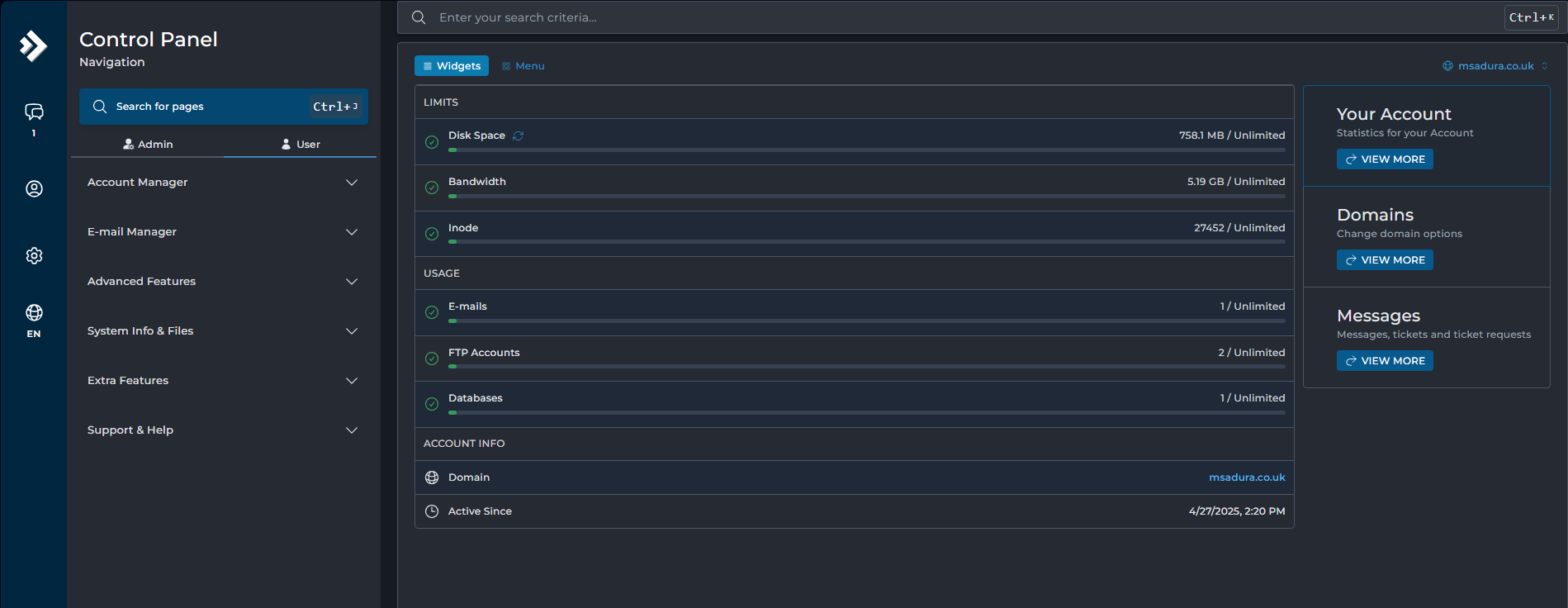
One of the features I appreciate most on the web-hosting side is the seamless Let’s Encrypt integration. Through the user-friendly DirectAdmin GUI, generating, applying, and auto-renewing SSL certificates for my domains is a completely hands-off, automated process.
Conclusion
DirectAdmin might not be the newest kid on the block, but when paired with enterprise-level routing, Fortinet ATP security, and a grandfathered license, it remains a powerhouse. It proves that you don’t always need the most expensive or heavily marketed software to run a top-tier hosting environment—you just need the right architecture around it.